Stages Of Tissue Culture
Mastering Teak Cultivation Through Tissue Culture

WE DO NOT HAVE ANY BRANCHES, FRANCHISES, MEDIATORS OR AGENTS.
Comprehensive analysis of tissue culture
S 1
Mother Plant Selection
S2
Suitable Explants
S3
Media Preparation
S4
Inoculation
S5
Incubation
S6
Rooting & Hardening

Stage 1 Of Tissue Culture
Mother Plant Selection
The first step in the tissue culture process is to select a high-quality mother plant. This plant should exhibit desirable traits such as fast growth, disease resistance, and superior wood quality. The mother plant must be thoroughly inspected to ensure it is free from diseases and pests. Selecting a robust mother plant is crucial as it will determine the genetic quality of the tissue-cultured progeny.
Stage 2 Of Tissue Culture
Collecting Suitable Explants
Once the mother plant is selected, small tissue samples, known as explants, are collected. These explants can be taken from various parts of the plant, such as leaves, stems, or buds. The collection process involves careful handling to avoid damage and contamination. The explants are then sterilized using disinfectants like ethanol or bleach to eliminate any surface contaminants. This step is essential to prevent infections during the culture process.
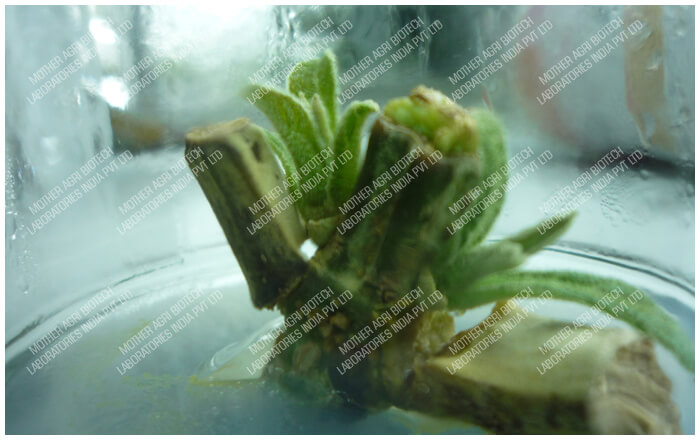
Stage 3 Of Tissue Culture
Media Preparation
The next step involves preparing a nutrient-rich culture medium. This medium must contain all the essential minerals, vitamins, hormones, and growth regulators required for the explants to grow and develop. The composition of the medium can vary depending on the specific requirements of the teak tissue. Once prepared, the medium is sterilized, usually by autoclaving, to ensure it is free from any microbial contamination
Stage 4 Of Tissue Culture
Inoculation
In this stage, the sterilized explants are placed into the prepared culture medium. This is done in a sterile environment, such as a laminar flow hood, to maintain aseptic conditions. The explants are carefully positioned in the medium to ensure optimal contact and nutrient absorption. The culture vessels are then sealed to maintain sterility and prevent contaminationhttps://motherbiotech.in/wp-content/uploads/2024/09/WhatsApp-Video-2024-09-04-at-17.21.30_45e31c33.mp4https://motherbiotech.in/wp-content/uploads/2024/09/inc.mp4
Stage 5 Of Tissue Culture
Incubation
The inoculated explants are incubated in controlled environmental conditions. This involves maintaining appropriate temperature, light, and humidity levels to promote growth and development. During this period, the explants will start to form shoots and roots. Regular monitoring is necessary to check for any signs of contamination or abnormalities. Sub-culturing may be performed to transfer the growing shoots to fresh medium, encouraging further proliferation.
Stage 6 Of Tissue Culture
Rooting and Hardening
Once shoots have developed, they are transferred to a rooting medium with specific hormones to promote root growth. After rooting, the young plantlets undergo primary hardening in a controlled greenhouse environment, gradually acclimatizing to lower humidity and more natural conditions. Secondary hardening follows, where plantlets are further adapted to outdoor conditions, making them ready for transplantation into the field. This gradual acclimatization ensures the plantlets can withstand environmental stresses in their natural habitat.https://motherbiotech.in/wp-content/uploads/2024/09/ROOTING.mp4